Enterprise AI needs a
control plane.
AI writes your code, runs your analyses, and makes decisions at scale. But nobody governs it. Nobody can prove what it did. AEGIS is the engineering control plane between every AI tool and your production.
The Multi-Heading Engineering Council
Not a chatbot group. A governed digital engineering organization — expert AI Heads with identity, personality and authority debate, challenge and decide alongside your engineers. Every engineering decision becomes auditable evidence.
A governed engineering session
AEGIS convenes the right Heads for each mission — DASH, IDENTITY, VELA, EDGE, CONSTITUTION — under a 20-step discussion protocol with explicit authority.
Disagreement is a first-class result
Authority-weighted decisions, security vetoes and preserved dissent. VELA can reject an insecure design; the objection stays in the Decision Record.
Decision-to-code traceability
Every task traces back to a Council decision, Head positions, objections and evidence — so "why does this implementation exist?" is always answered.
VELA 15-Level Cyber Security
Don't buy another security product. Build your security capability. VELA is the 15-engine cyber engineering control plane — software, hardware and firmware security factories under one governance plane.
15 dedicated security engines
Cyber Asset, Threat Intelligence, Risk, Vulnerability, Policy, Architecture, Software/Hardware/Firmware Factories, Detection, Response, Automation, Validation Lab, Evidence & Orchestration.
IT + OT + IoT in one fabric
Sovereign control over protected infrastructure — PLC, SCADA, RTU, industrial controllers, edge gateways and cloud workloads under a single Cyber Digital Twin.
Evidence-grade assurance
Detection, response, validation and evidence chains deliver proof-ready compliance, audit trails and a verified cyber state.
AEGIS at a glance
One diagram, the entire governance layer — every AI model, application and physical system under a single AEGIS control plane.
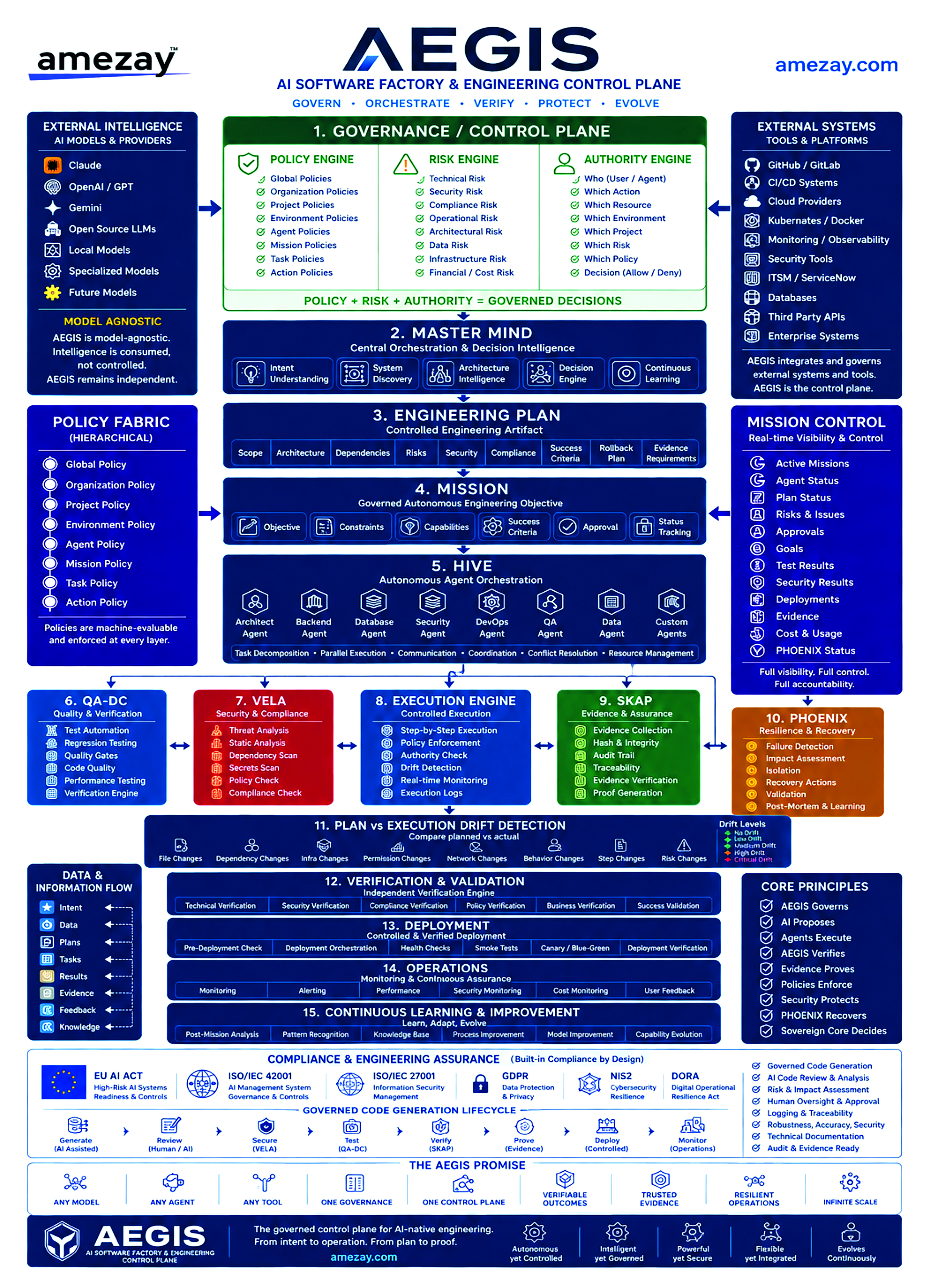
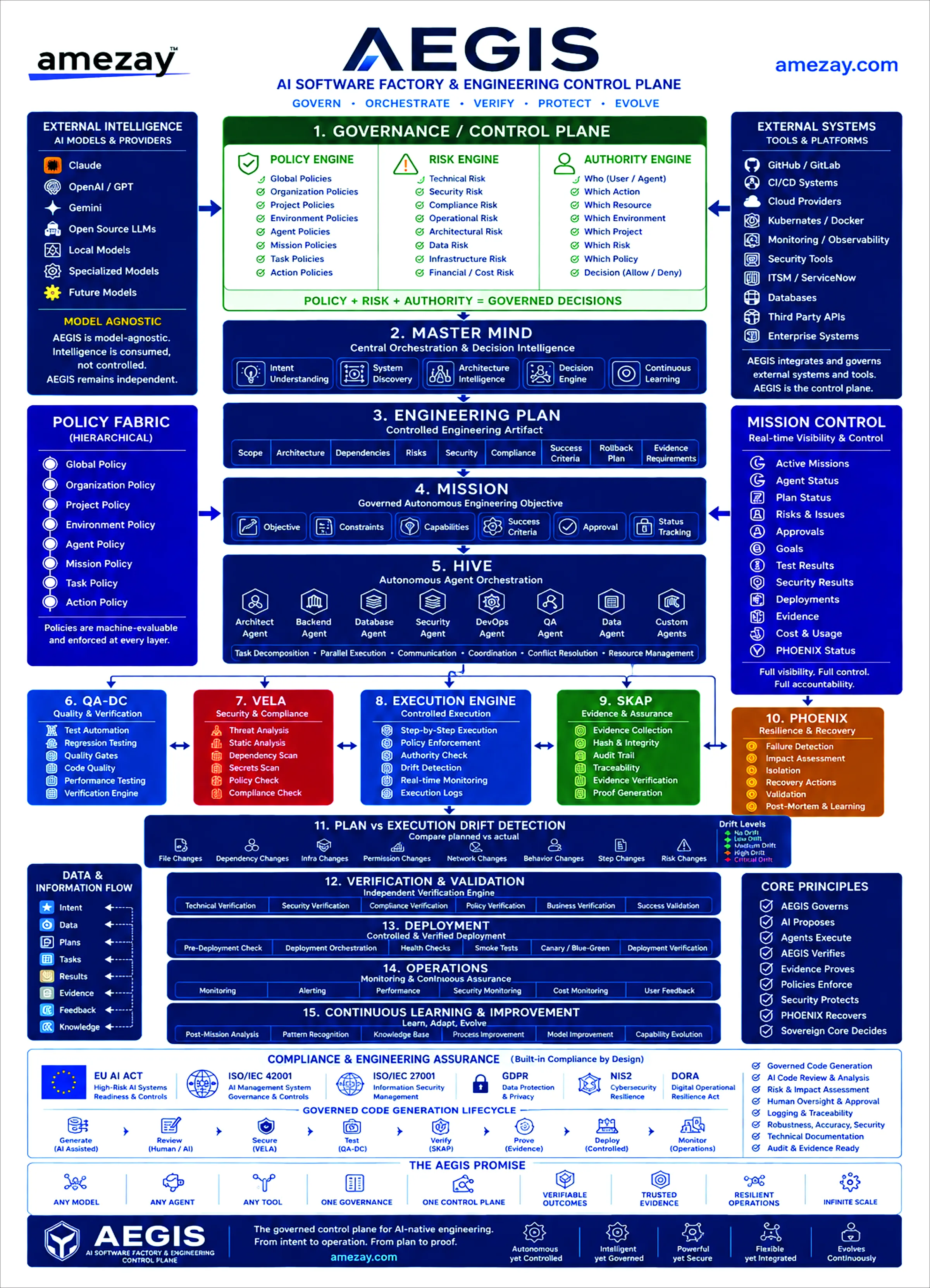
The Amezay Ecosystem.
Real numbers from the live production system. Not projections, not targets — verified metrics.
Enterprise AI doesn't have a technology problem.
It has a control problem.
Your teams deploy AI faster than you can govern it. The gap between AI adoption and AI control is widening every week. Here's what that costs you.
The Governance Void
Description
Your finance team uses ChatGPT for reports. Engineers ship code with Copilot. Customer service runs on an LLM. None of it is audited. None of it has an evidence trail. When something goes wrong, you can't prove what the AI decided, why it decided it, or who authorized it.
Why it matters
73% of enterprise AI deployments have zero governance framework. Not weak governance. Zero. No rules engine. No audit trail. No tamper detection.
AEGIS response
Constitution-as-code with 38 forbidden acts and 20 mandatory duties enforced programmatically. Machine-readable law registry — every rule versioned and auditable. Per-tenant governance overlays that cannot weaken platform security. Evidence chain on every AI decision: input, output, reasoning, approval.
The Evidence Gap
Description
AI says "done." Did it run the tests? AI generates a report. Did it actually analyze anything, or hallucinate the results? There is no evidence chain. No command output captured. No SHA-256 hash of what changed. No diff. No regression proof. You make business decisions based on AI claims that can't be verified.
Why it matters
An AI agent completing 100 tasks per day produces zero verifiable evidence for 97 of them. You're trusting a black box that trusts itself.
AEGIS response
Evidence-based completion: "It works" is not accepted — "here's the proof it works" is. Command output, test results, diffs, and SHA-256 checksums captured automatically. Tamper-evident baseline. QA-DC verification gates before any completion claim is accepted.
The Integration Wall
Description
AI can write a Python script. It cannot read a PLC register and adjust conveyor speed. It cannot parse a sensor anomaly and trigger predictive maintenance. It cannot coordinate 50 robots across 3 production lines. Your PLC controllers run Modbus. Your SCADA systems speak OPC-UA. Your sensors output raw analog signals. AI without physical integration is a chatbot with ambitions.
Why it matters
89% of manufacturing AI projects fail at the integration layer. The AI works fine in the cloud. The factory doesn't run in the cloud.
AEGIS response
Direct PLC communication via Modbus, OPC-UA, Profinet. Real-time SCADA bridge into factory control loops. Sensor fusion across temperature, pressure, vibration, optical, and custom sensors. Multi-robot kinematic command generation. Edge inference on-premise with air-gap support.
The Factory Problem
Description
Every AI project starts from scratch. Company A builds an AI chatbot. Company B builds an AI chatbot. Same problems. Same mistakes. Same infrastructure. No reusable patterns. No composable architecture. No blueprint that says "here's how you build, govern, and deploy AI systems — every time, consistently, with evidence."
Why it matters
Enterprise AI teams spend 60% of their time on infrastructure and governance, 30% on integration, and only 10% on actual intelligence. The intelligence is the easy part.
AEGIS response
The Software Factory: automated architecture blueprints per project, H13R 13-gate quality system from tenant isolation to production, multi-tenant build-once-deploy-to-N model, SKAP-tracked continuous evolution based on verified results.
The Compliance Trap
Description
EU AI Act requires risk classification for every AI system, transparency for GPAI models, human oversight, tamper-proof audit trails. ISO 42001 requires AI management systems. NIST AI RMF requires GOVERN/MAP/MEASURE/MANAGE lifecycle. None are optional. All require evidence you don't have.
Why it matters
The average enterprise has 47 AI systems in production. Zero have a compliance framework. The deadline is already here.
AEGIS response
Compliance is architectural, not bolted on: regulation mapping matrix covering EU AI Act, ISO 42001, NIST AI RMF, and IEC 62443 — scored by EDGE across 12 dimensions, enforced by human oversight gates, proven by the tamper-evident evidence chain, delivered as audit-ready reporting.
The Vendor Prison
Description
Your entire AI stack is tuned for one model. The provider changes pricing, deprecates the model, or breaks the API. Your fine-tuned prompts break. Your RAG pipeline breaks. Your cost model breaks. Vendor independence isn't a nice-to-have. It's survival.
Why it matters
Average AI vendor lock-in migration cost: 3-6 months engineering, $500K-$2M in rework. And complete loss of institutional knowledge.
AEGIS response
AEGIS supports OpenAI, Anthropic, Google, Mistral, Ollama, and any OpenAI-compatible endpoint. Switch models, providers, and frameworks without changing your governance, compliance, or evidence chain. Designed for model and provider independence.
The Scale Illusion
Description
AI works in the demo. It fails in production. Single tenant? Flawless. Add 10 tenants, 100 concurrent users, 1,000 decisions per second, real-time latency, per-tenant data isolation, disaster recovery — suddenly your "working" system is a house of cards.
Why it matters
94% of enterprise AI pilots never make it to production. Not because AI doesn't work. Because the infrastructure around it can't handle reality.
AEGIS response
Enterprise infrastructure built for reality: 10-layer tenant isolation, zero-access architecture where even administrators cannot read tenant data, high-availability failover, automated rollback on every deployment, sovereign hosting on your own infrastructure.
MMIMM — Mandate Inventory
What it does
Every project starts with a mandate matrix. Who authorized what, under which governance, with what constraints. No AI project begins without explicit mandate.
FIPR — First-In, First-Verified
What it does
Every commit verified before merge. No unreviewed AI code enters the codebase. 13-gate system ensures quality, security, and evidence at every step.
H13R — 13-Gate System
What it does
Architecture, code quality, security, testing, documentation, compliance, deployment readiness — 13 gates, each producing evidence. No gate bypassed.
DIO — Dev Integration Orchestrator
What it does
Connects to your existing CI/CD, version control, and deployment pipelines. AEGIS orchestrates without replacing your infrastructure.
QA-DC — Quality Assurance & Dependency Certification
What it does
The verification backbone of AEGIS: 20 verification types covering protocol obedience, code quality, security scanning, evidence collection, regression detection, and documentation verification. Every engineering heading passes through QA-DC before completion.
EDGE — 12-Dimension Engine
What it does
Scores engineering work across 12 dimensions so risk and complexity are known before execution begins. Feeds regulation mapping with per-dimension scoring.
SKAP — Blueprint Tracking
What it does
Every heading is tracked via SKAP blueprints from creation to verified completion — scope, dependencies, and evidence linked end to end.
VELA — AEGIS Cyber Defence
What it does
VELA is AEGIS's cyber-defence organ — not a separate product. The hierarchy is Amezay → AEGIS → VELA. It scans for vulnerabilities and policy violations across dependencies, secrets, OWASP top 10, and containers, and issues the independent Gate 5 security verdict on every deployment. Findings block progression until resolved — security is a gate, not a suggestion.
Autonomous ≠ Uncontrolled
The problem isn't AI capability. The problem is AI control. AEGIS exists to solve that — not to slow AI down, but to make it governable, verifiable, and deployable at enterprise scale.
AI Agents
Autonomous capability enters your organization here.
AEGIS
Every action passes through governance before it reaches production.
Production
Governed, verified, evidenced systems running your business.
AEGIS: The Engineering Control Plane
AEGIS is not another AI tool. It's the platform that governs all your AI tools, builds new systems from scratch, and connects AI to the physical world.
GOVERNANCE ENGINE — The Brain
You don't govern AI. AEGIS does. Constitution-as-code with 38 forbidden acts and 20 mandatory duties enforced programmatically. Law registry: every rule machine-readable, versioned, auditable. Tamper-evident baseline with SHA-256 checksums. Per-tenant governance overlays — tenants cannot weaken platform security. Evidence chain: every AI decision logged with input, output, reasoning, and approval.
This is not "AI ethics." This is AI law enforcement.
SOFTWARE FACTORY — The Hands
AEGIS doesn't just govern AI. It builds complete AI-powered systems — from concept to deployment. Automated architecture blueprints per project. 13-gate quality system (H13R) from tenant isolation to production. Evidence-based completion: "It works" is not accepted. "Here's the proof it works" is. Multi-tenant factory: build once, deploy to N tenants. Continuous evolution based on verified results.
This is not "AI-assisted coding." This is AI-engineered systems — built, verified, governed, deployed.
PHYSICAL INTEGRATION — The Bridge
AEGIS connects AI to the physical world. PLC integration: direct communication with industrial controllers via Modbus, OPC-UA, Profinet. Sensor fusion: ingest data from temperature, pressure, vibration, optical, and custom sensors. SCADA bridge: real-time connection to factory control loops. Robotic coordination: multi-robot kinematic command generation. Autonomous vehicle interface: sub-millisecond decision loops. Edge computing: AI inference on-premise with air-gap support.
This is not "IoT analytics." This is AI that touches, controls, and optimizes physical reality.
Traditional AI vs AEGIS
The difference between AI tools and an AI engineering control plane.
From digital to physical
AEGIS governs AI across every layer — from cloud software down to machines that move.
DIGITAL
Data & decisions
SOFTWARE
Applications & agents
INFRASTRUCTURE
Servers & networks
INDUSTRIAL
ERP · SCADA · control loops
PHYSICAL
Robots · vehicles · lines
"AI without governance is liability. AI without evidence is guessing. AI without physical integration is a chatbot. AEGIS gives you all three — governed, evidenced, physical."
Built for the people responsible for what ships.
AEGIS serves every stakeholder in the AI lifecycle — from the C-suite setting strategy to the engineers running production.
CTO / CIO
You're accountable for AI code quality and delivery speed. AEGIS gives you a single control plane — governance, evidence, and deployment in one platform. Stop managing 12 disconnected AI tools.
CISO / Security Lead
Shadow AI is your biggest blind spot. AEGIS inventorizes every AI system, enforces security policies, and produces tamper-proof audit trails. Know exactly what AI is doing in your environment.
Engineering Leadership
Your team ships AI-generated code daily. AEGIS gates every change — quality, security, evidence. No code passes without proof. No deployment happens without governance. Your developers stay productive, your production stays stable.
CEO / Board
You're building the future. AEGIS ensures what you build is governable, compliant, and production-ready from day one. Ship faster, prove everything, and never face an auditor you can't answer.
Government & Regulated Enterprise
National-scale and regulated programs demand absolute control. AEGIS runs air-gapped on sovereign infrastructure — your data center, your models, your keys — with tamper-evident evidence chains and human oversight gates built for the strictest scrutiny.
Chief Compliance Officer
EU AI Act, ISO 42001, NIST AI RMF — the deadlines are here. AEGIS produces compliance evidence for every AI decision, retroactively if needed. From zero to audit-ready in weeks, not years.
Industrial / Operations Director
Your factory has PLCs, SCADA systems, sensors, and robots. Off-the-shelf AI can't touch them. AEGIS bridges software intelligence with physical operations — from PLC register reads to multi-robot coordination.
Product / Program Manager
You need AI projects delivered on time with evidence of progress. AEGIS blueprints every project, tracks every task, and produces verifiable completion records. No more "it's almost done" — you see the proof.
DevOps / Platform Engineer
You manage the infrastructure AI runs on. AEGIS handles multi-tenant isolation, container orchestration, health monitoring, and automated rollback. Your platform becomes self-governing.
Data / AI Research Lead
You train models and run experiments. AEGIS tracks every inference, every training run, every model version with full audit trails. GPU scheduling across your fleet with cost governance.
The question isn't "should we use AI?"
It's "can you prove what your AI did?"
Every organization uses AI. Very few can prove what it produced, who authorized it, and whether it met standards. AEGIS changes that — for every AI system, every decision, every deployment.
Evidence, not claims
Every AI output comes with command output, test results, SHA-256 hashes, and timestamped logs. "It works" is replaced by "here's the proof."
Governance, not guidelines
Rules enforced in code, not documentation. The AI cannot bypass governance. Neither can a developer. Neither can a vendor.
Control, not restriction
AEGIS doesn't slow you down. It removes the risk of going fast. Ship with confidence because every change is verified before it reaches production.
You have 12+ AI tools. They don't talk to each other.
Your chatbot doesn't know what your analytics engine found. Your code generator doesn't know what your security scanner flagged. Each AI is an island. Nobody orchestrates. Nobody reconciles. Nobody ensures the output of one system is the input of another.
One control plane. Every AI system.
AEGIS coordinates 86+ engineering specializations through a single orchestration layer. From idea to architecture to deployment to evolution — every phase governed, every output evidenced.
ANALYZE
Every engagement begins with structured analysis: requirements, constraints, and target architecture are captured before any agent acts — scored by EDGE across 12 dimensions.
Single-agent architecture
One AI agent performs all tasks. No parallel sessions. No sub-agents. No third-party agents. Complete accountability from start to finish.
86+ engineering headings
Every heading is tracked via SKAP blueprints, scored by EDGE (12-dimension engine), and verified by QA-DC. No heading completes without evidence.
Continuous evolution
Systems self-improve based on verified results, not opinions. Every improvement logged with before/after evidence. Drift detected within 24h.
What AEGIS makes measurable.
Every governed action produces countable, verifiable system outputs. These are generated by your instance, for your deployment — not market benchmarks. Measurable engineering control, owned by you.
AI actions governed
Every agent action passes the control plane — nothing bypasses policy.
Policies enforced
Constitution-as-code rules applied programmatically on each action.
Approvals recorded
Human oversight gates captured with who, what, and when.
Tests verified
Structured pass/fail results linked to every change — no unverified claims.
Security gates passed
VELA scans and H13R13-Region Governance — multi-jurisdiction security gates. security gates produce per-change outcomes.
Evidence artifacts generated
Command output, diffs, hashes, timestamps — 5+ artifacts per decision.
Deployments authorized
Releases proceed only when every prior gate holds evidence.
Policy violations detected
Violations surface before merge — blocked, logged, and attributable.
Audit records created
Tamper-evident records accumulate into an always-ready audit trail.
What you get when AI is governed.
Risk Elimination
Every AI decision traceable. Every deployment evidenced. Every compliance requirement met. You stop accumulating AI liability and start accumulating AI evidence.
Speed with Confidence
Governed AI moves faster than ungoverned AI. Why? Because every change is verified before it reaches production. No rollbacks from untested AI code. No production incidents from ungoverned changes.
Competitive Moat
Your AI is governed, evidenced, and compliant. Your competitor's isn't. When the auditor arrives, when the regulator asks, when the lawsuit files — you have proof. They don't.
Rivals write code.
AEGIS delivers the project.
GitHub Copilot writes lines. Devin writes features. AEGIS writes entire systems — governed, evidenced, multi-tenant, production-ready, with hardware blueprints included. They are hammers. AEGIS is the entire factory.
Your servers. Your data. Your control.
AEGIS runs where you need it — not where a vendor decides.
On-Premise
Your servers, your network, your control. Full AEGIS functionality with zero data leaving your infrastructure.
Hybrid
Cloud orchestration with on-premise data. Sensitive workloads stay local. Coordination happens where it's efficient.
Air-Gapped
No internet required. Full functionality in classified, regulated, and disconnected environments. Designed for government and defense.
Edge
AI inference at the point of action. On the factory floor. In the vehicle. At the sensor node. Latency-sensitive workloads where the cloud can't reach.
From Foundation to Sovereignty.
The AEGIS platform evolves through verified milestones — each one producing evidence, not promises.
The enterprises that adopt AI governance now will define the next decade.
AEGIS is the most comprehensive AI engineering platform being built today. It covers governance, software factory, physical integration, compliance, and sovereign deployment — in a single, unified system. The enterprises that join this program now gain early access, direct influence on the roadmap, and a position at the forefront of governed AI infrastructure.
Early Access
Deploy AEGIS in your environment before general availability. Shape the platform with your requirements and use cases.
Roadmap Influence
Your requirements drive the engineering priorities. Direct line to the founding team. Your use case becomes a core capability.
Competitive Position
When AI governance becomes mandatory — and it will — you're already there. Your competitors are still evaluating. You're already compliant.
EU AI Act enforcement begins. Are you ready?
August 2, 2026 — the date high-risk AI systems must comply. After this date, non-compliant organizations face fines up to €35M or 7% of global annual turnover. Every AI-generated decision made without governance is a permanent gap in your audit trail.
Fines
Up to €35M or 7% of global annual turnover for high-risk AI system violations. For SMEs, up to €1.5M or 3% of turnover.
Market Bans
Non-compliant AI systems can be banned from the EU market entirely. Products withdrawn. Services suspended. Contracts terminated.
Evidence Gaps
Evidence chains cannot be created retroactively. Every AI decision made before governance is a permanent, unfillable gap in your audit trail.
The question isn't whether you need AI governance.
It's whether you'll have it before the deadline — or after the fine.
Every claim backed by evidence.
When AI writes the code, the evidence is the asset. Every AEGIS output comes with timestamped logs, hash-chained verification, and audit-ready documentation. Not "it works" — here's the proof it works.
Timestamped
Every change, every decision, every deployment logged with precise timestamps. When it happened, who authorized it, what was affected.
Hash-Chained
SHA-256 checksums link every artifact to its predecessor. Tamper with one record, and the entire chain breaks. Integrity is mathematical, not trust-based.
Audit-Ready
ISO 27001, SOC 2, KVKK/GDPR, EU AI Act — evidence organized by compliance framework. Auditor asks, you answer. Instantly.
Built for regulation. Not bolted on.
AEGIS aligns with major AI regulatory frameworks — not as a checkbox, but as a core architectural principle.
EU AI Act
Risk classification for every AI system. GPAI transparency. Human oversight requirements. Tamper-proof audit trails. Full enforcement August 2026.
ISO 42001
AI management system standard. Statement of Applicability. Continuous improvement cycle. Organizational AI governance framework.
NIST AI RMF
GOVERN / MAP / MEASURE / MANAGE lifecycle. Model inventory and tracking. Risk assessment and response. Continuous monitoring.
IEC 62443
Industrial automation and control systems security. For manufacturing and critical infrastructure deployments.
Your AI provider changes.
Your governance doesn't.
AEGIS supports OpenAI, Anthropic, Google, Mistral, Ollama, and any OpenAI-compatible endpoint. Switch models, providers, and frameworks without changing your governance, compliance, or evidence chain. Designed for model and provider independence.
Every regulation. Mapped to AEGIS.
| Regulation | Requirement | AEGIS Coverage |
|---|---|---|
| EU AI Act Art. 9 | Risk management system | EDGE 12-dimension scoring |
| EU AI Act Art. 11 | Technical documentation | Evidence chain + SKAP blueprints |
| EU AI Act Art. 12 | Record-keeping | Timestamped, hash-chained audit trail |
| EU AI Act Art. 13 | Transparency | Model registry + decision logs |
| EU AI Act Art. 14 | Human oversight | 7 Gates gates + approval workflows |
| ISO 42001 | AI management system | Constitution v5.1 + governance engine |
| NIST AI RMF | GOVERN/MAP/MEASURE/MANAGE | FIPR + H13R + QA-DC lifecycle |
| SOC 2 | CC6.8/CC7.1/CC8.1 | Zero-access architecture + evidence |
| KVKK | Data protection | 10-layer tenant isolation + RLS |
Your data never leaves your control.
AEGIS supports fully sovereign deployments — on-premise, air-gapped, and edge. Your AI infrastructure runs on your terms, in your jurisdiction, under your governance.
Data Sovereignty
All data stays within your infrastructure. No telemetry sent to Amezay. No cloud dependency. Your bytes, your rules.
Jurisdictional Compliance
Deploy in-country to meet data residency requirements. GDPR, KVKK, LGPD, PIPL — AEGIS runs wherever regulation demands.
Air-Gap Ready
Full functionality without internet. Model inference, governance, evidence, deployment — all offline-capable.
On-Premise
Your data center
Private Cloud
Dedicated tenancy
Hybrid
Mixed estate
Air-Gapped
Fully disconnected
Edge
Factory & vehicle
BYOK
Your keys, your rules
Sovereign Core Escalation Ladder
Every request is solved at the lowest capable layer. AI is invoked, never required.
Deterministic
Policy, access control, schema validation, state machines
Symbolic
Rule reasoning, dependency checks, constraint solving
Knowledge
Structured queries: actors, services, deployments, tenants
Statistical
Embeddings, classification, anomaly detection — small models on CPU
Generative
Code gen, summarization — bounded, budgeted, policy-gated
Human
Mandatory approval gates, unresolved ambiguity
When AI writes the code, the evidence is the asset.
AEGIS produces verifiable evidence for every AI action. Not logs. Not breadcrumbs. Cryptographically linked, tamper-evident proof.
Command Output
Every command executed by AI is captured with full output, exit code, and stderr. No silent failures.
Test Results
Every test run produces structured results — pass/fail, coverage, regression detection. No "tests passed" without proof.
SHA-256 Hashes
Every file change, every artifact, every deployment is checksummed. Before and after. Tampering detected instantly.
Action → Policy → Validation → Approval → Deployment → Evidence
The cost of ungoverned AI is higher than the cost of AEGIS.
Compliance Savings
12-18 months of compliance work compressed to 2-4 weeks. Audit preparation from weeks to hours. Regulatory fines avoided.
Incident Reduction
Measured deployment failure rates significantly reduced through governed release processes. Fewer production incidents. More building, less firefighting.
Speed to Market
Governed AI ships faster. No rework from ungoverned changes. No rollbacks from untested code. No delays from missing evidence.
86+ engineering specialties. One unified system.
AEGIS is designed to unify this breadth under one governance framework with one evidence chain. It doesn't replace your tools — it governs them.
Software
Backend APIs, databases, and server logic · Frontend UI/UX, components, responsive design · Mobile iOS, Android, cross-platform.
Part of a unified platform.
AEGIS doesn't work alone. Every module below is integrated, governed, and secured under the same control plane.
Amezay EMAIL
Multi-nation, multi-tenant email delivery with VELA security, CRM integration, and full ecosystem coordination.
Explore EMAIL →CRM360
360-degree customer view. Call recording, pipeline, deals, lead scoring, and auto-deduplication — all tenant-isolated.
Explore CRM360 →EDGE
Evolution Governance Engine. 12-dimension scoring, 4 decision thresholds, 51/51 tests — what to build, when, and why.
Explore EDGE →CRAFT
Independent Global Trusted Manufacturing & Commerce Network. Tenant-isolated master/sub-dealer commerce under AEGIS governance.
Explore CRAFT →RIE
Remote Infrastructure Engineering. Server, database, network, container & DR — diagnosed, remediated and verified with evidence-backed reporting.
Explore RIE →AEGIS
AI Engineering Control Plane. 760/786 tests verified, approval gates, drift detection and an unforgeable audit trail for everything that ships.
Explore AEGIS →The entire industry is building AI.
AEGIS is building the infrastructure to govern it.
Copilot writes code. Devin writes features. AEGIS writes entire systems — governed, evidenced, multi-tenant, production-ready, with hardware blueprints included. They are hammers. AEGIS is the entire factory. The enterprises that build with AEGIS today define the standards tomorrow.
Unique Position
Governance engine + software factory + physical integration designed as one system. This full breadth is AEGIS' core focus.
First-Mover Advantage
Enterprise AI governance is an emerging market. The enterprises that establish their infrastructure now will have a structural advantage for years. That window is closing.
Co-Builder Model
Founding enterprises don't just use AEGIS. They shape it. Their requirements become core capabilities. Their use cases become reference architectures. Their teams become the first to master governed AI infrastructure.
Build your own cybersecurity capability.
VELA is the cybersecurity engineering layer of AEGIS. It enables organizations to build, govern and continuously evolve their own security capabilities — within their own infrastructure, policies and operational boundaries.
For governments and critical organizations
Cybersecurity infrastructure should not become another strategic dependency. AEGIS + VELA provides a path toward building security capabilities inside your own infrastructure and governance boundary.
Security Architecture
Vulnerability Scanning
Dependencies, containers, infrastructure-as-code. CVE tracking with severity scoring. Critical vulnerabilities trigger immediate alerts.
Configuration Audit
Every service configuration checked against security baselines. Drift from hardened configurations detected and reported.
Compliance Monitoring
Continuous verification against regulatory frameworks. Non-compliance detected in real-time, not during annual audits.
Security engineered into the lifecycle
Security is not a scan added after development. It is engineered into every stage of the software lifecycle.
Security events become evidence
86+ specializations. One platform. Every heading tracked.
Every engineering capability is tracked via SKAP blueprints, scored by EDGE (12-dimension engine), and verified by QA-DC. No heading completes without evidence.
Software Factory
MMIMM, FIPR, H13R, QA-DC, DIO — autonomous project development from scratch, governed end-to-end.
Hardware Planning
Planner module live (734 lines). Productivity and compatibility analysis. BOM generation. 4-day estimate for full manufacturing pipeline.
Infrastructure
Multi-tenant isolation (10 layers), container orchestration, health monitoring, automated rollback, edge computing.
QA-DC
20 verification types per heading. Protocol obedience. Evidence collection. No heading completes without proof.
Not just code generation. Full-stack project orchestration.
AEGIS builds software projects from scratch — from idea to architecture to code to deployment to evidence. Every phase governed by MMIMM (Mutual Mandate Inventory Matrix), every change verified by FIPR (First In, First Verified Protocol), every task tracked by H13R (13-gate completion system).
Idea
A business need enters the factory as a structured concept. MMIMM records who authorized it, under which governance, and with what constraints — before any agent acts.
The proprietary architecture behind the factory
Every module is purpose-built, evidence-producing, and governed by the same constitution.
MMIMM — Mandate Inventory
Every project starts with a mandate matrix. Who authorized what, under which governance, with what constraints. No AI project begins without explicit mandate.
FIPR — First-In, First-Verified
Every commit verified before merge. No unreviewed AI code enters the codebase. 13-gate system ensures quality, security, and evidence at every step.
H13R — 13-Gate System
Architecture, code quality, security, testing, documentation, compliance, deployment readiness — 13 gates, each producing evidence. No gate bypassed.
DIO — Dev Integration Orchestrator
Connects to your existing CI/CD, version control, and deployment pipelines. AEGIS orchestrates without replacing your infrastructure.
Multi-tenant. Zero-access. Self-healing.
10-layer tenant isolation. Zero-access architecture. Automated health monitoring and rollback. AEGIS infrastructure is built for enterprise workloads where failure is not an option.
10-Layer Tenant Isolation
Database, network, file system, process, memory, CPU, disk I/O, network I/O, encryption keys, audit logs — every layer isolated per tenant. Database-level isolation enforced automatically.
Zero-Access Architecture
No user, no AI model, no API call can access another tenant's data. Not by configuration. By architecture. Isolation is structural, not policy-based.
Automated Health & Rollback
Continuous health monitoring across all services. Degradation detected automatically. Rollback triggered without human intervention. Mean time to recovery: seconds, not hours.
20 verification types. No heading completes without proof.
Quality Assurance & Dependency Certification — the verification backbone of AEGIS. Every engineering heading passes through QA-DC before completion. No exceptions. No shortcuts.
Protocol Obedience
Did the AI follow the prescribed protocol? Verified against SKAP blueprint. Non-compliance blocks completion.
Code Quality Gate
Linting, complexity analysis, dead code detection, naming conventions. Automated with configurable thresholds.
Security Scan
Dependency vulnerabilities, secret detection, OWASP top 10, container scanning. No known vulnerabilities allowed.
Evidence Collection
Command output, test results, SHA-256 hashes, timestamps — all collected and linked. Evidence chain is tamper-evident.
Regression Detection
Before/after comparison on every change. New regressions detected automatically. No degradation passes unnoticed.
Documentation Verification
Every heading produces documentation. QA-DC verifies completeness, accuracy, and consistency with the actual implementation.
Self-improving. Evidence-based.
AEGIS doesn't just deploy and forget. It monitors, evaluates, and evolves — based on verified results, not opinions. Drift is detected. Improvements are logged. Every evolution is evidenced.
Drift Detection
Within 24h, AEGIS detects performance drift, security degradation, and compliance gaps. Automated alerts trigger remediation workflows.
Evidence-Based Improvement
Every improvement is logged with before/after evidence. No "we think it's better" — here's the measured difference, timestamped and hash-chained.
Automated Remediation
Where supported by infrastructure, AEGIS automates rollback, retry with adjusted parameters, and escalation when automation isn't sufficient. Production stays stable.
Deployed in days. Governed for decades.
AEGIS is designed for rapid enterprise deployment. Pre-built connectors, standard integrations, and proven deployment patterns get you from evaluation to production in weeks.
Discovery & Assessment
Map your AI landscape. Identify governance gaps. Produce a deployment plan with clear milestones and evidence checkpoints.
Core Deployment
Deploy governance engine, multi-tenant infrastructure, and evidence chain. Connect to existing AI tools and workflows.
Integration & Calibration
Connect to your CI/CD, version control, monitoring, and compliance systems. Calibrate governance rules to your organizational requirements.
Production & Evolution
Go live with full governance. Monitor, evaluate, and evolve. AEGIS adapts to your changing requirements and regulatory landscape.
Enterprise-ready. Evidence-verified.
AEGIS is built for environments where downtime is unacceptable and compromise is unthinkable.
High Availability
Active-active deployment with automatic failover. Zero-downtime updates. Health monitoring with sub-second detection.
Disaster Recovery
Automated backups with point-in-time recovery. Cross-region replication. Recovery time objectives measured in minutes.
Performance at Scale
Designed to handle concurrent AI systems, growing evidence archives and expanding audit histories. Recovery and evidence architecture scales with your infrastructure.
One ecosystem. Different responsibilities.
AEGIS is not a collection of disconnected tools. Its engineering capabilities work together across governance, security, software engineering, infrastructure, recovery and continuous improvement — within one governed lifecycle.
Core Engineering
The control, coordination, execution, lifecycle and resilience capabilities that form the foundation of AEGIS.
The central governance and orchestration layer for all AI systems.
Coordinates governed workers, agents, tasks, applications and tenant environments across AEGIS.
Persistent memory and context layer that enables continuous engineering awareness.
Protects critical system state, maintains recovery paths and executes configured recovery procedures when failure conditions occur.
Records verified working deployment states, enabling controlled rollback where supported.
Continuous improvement mechanism — AEGIS identifies, plans, executes and verifies improvements to its own engineering ecosystem.
Ensures every change is fully implemented or cleanly reverted — no partial states, no silent failures.
Security & Trust
Capabilities responsible for protecting, isolating and validating enterprise environments.
Continuous security evaluation — vulnerability detection, policy enforcement, dependency analysis and security evidence.
Verified identity and trust chain across all system components.
Enforced separation of identity, data, secrets and execution across tenant environments.
Secure storage and lifecycle management for credentials, keys and sensitive configuration.
Software Engineering
The engineering capabilities through which AEGIS builds, tests, deploys and continuously improves software.
Governed build, test and deployment pipeline with full evidence generation.
Eight verification mechanisms — compile, unit test, coverage, mutation, lint, security, SCA and architecture score.
35 forbidden acts, 20 mandatory duties, 7-level penalty system — the operational law of the ecosystem.
Module & Application Library
A tenant does not need to rebuild every enterprise capability from zero. Where appropriate, AEGIS reuses existing modules, adapting and integrating them while preserving governance.
Different responsibilities. One governed engineering lifecycle.
When infrastructure fails,
recovery should already be engineered.
PHOENIX is AEGIS's resilience and recovery engineering capability. It protects critical system state, maintains defined recovery paths and can execute configured recovery procedures when qualifying failure conditions occur.
Continuous Protection
Critical data and system state protected according to defined recovery policies.
Autonomous Recovery
Configured recovery procedures executed when supported failure conditions are detected — no manual intervention required for each step.
Isolated Recovery Paths
Recovery paths maintained that can be separated from the affected environment.
Recovery Objectives
Recovery architecture designed around your organization's RPO and RTO requirements.
Recovery with Proof
Recovery actions and validation results become part of the AEGIS evidence chain — proof, not promises.
Resilience Across Failure Domains
Recovery architectures designed around infrastructure, geographic and operational failure boundaries.
Security and Resilience
A secure system still needs to survive failure. VELA protects against threats. PHOENIX prepares for failure and recovery.
AEGIS controls the system. VELA protects the system. Phoenix keeps the system recoverable. QA-DC verifies. Evidence proves what happened.
HIVE Ecosystem Coordination
HIVE is the central operating environment of the Amezay AI ecosystem. It coordinates governed agents, workers, tasks, engineering workflows, applications and tenant environments so AEGIS operates as one integrated engineering system.
Multi-Tenant by Architecture
The Amezay ecosystem serves multiple tenant environments while maintaining defined boundaries for identity, data, secrets, execution and governance.
Governed Agent Coordination
Workers and agents operate within constitution-defined boundaries. Every action is tracked. Every state change is recorded.
Reusable Software Capabilities
Where appropriate, AEGIS reuses existing modules and applications, adapting them into the tenant's project while preserving governance and security.
Not what HIVE is not
HIVE may interact with these types of systems where technically appropriate. They are not its identity.
Six core capabilities
Persistent Memory with Vector Search
Every AI worker's observations, decisions, and results are saved with semantic embeddings. Workers start each session with full context from previous sessions. No cold starts. No lost knowledge.
Structured Knowledge Management (LMD)
Lessons learned are captured, reviewed, approved, and promoted through confidence tiers. LMD entries are the system's learned reflexes — things the AI knows to do (or not do) based on past experience.
Immutable Event System
Every operation — every file change, every command, every decision — is logged as an event. Events form an unbreakable chain of custody for all ecosystem activity.
Heading Orchestration
88+ active headings track every development area in the ecosystem. Each heading has its own context, memory scope, and task queue. HIVE ensures workers operate within the correct context.
Worker Lifecycle Management
Workers register on startup, send heartbeats, and unregister on shutdown. The system tracks which workers are active, what they're working on, and their resource usage.
Knowledge Graph
Entities and their relationships are stored in a knowledge graph. Workers navigate the graph to discover related context they might not have explicitly searched for.
Architecture: One Integrated System
| Decision | Choice | Why |
|---|---|---|
| Database | PostgreSQL 18 + pgvector | Single DB for structured + vector data |
| API Framework | Raw Node.js HTTP | Zero dependencies, full control |
| Auth Model | Bearer token per worker | Simple, traceable, stateless |
| Embedding | Local pipeline | Privacy, offline-capable, zero API costs |
| Deployment | systemd on bare metal | Simple, reliable, no k8s overhead |
| Multi-Tenancy | Database Isolation | 108 mandatory security rules, zero bypass |
Multi-Tenant by Design: 10-Layer Isolation
HIVE is not multi-tenant as an afterthought. It is multi-tenant by architecture.
HIVE Capabilities
| Capability | Amezay HIVE |
|---|---|
| AI-Native Multi-Tenancy + RLS | ✓ Built-in — 10-layer isolation |
| Immutable Audit Chain | ✓ Full cryptographic evidence chain |
| Knowledge Graph Built-In | ✓ Native graph engine |
| LLM Cost Intelligence | ✓ Per-model cost tracking |
| Self-Healing + Agent Templates | ✓ Automated recovery & templates |
| Zero Vendor Lock-In | ✓ Model-independent, provider-agnostic |
| GPU Optional | ✓ CPU-first architecture |
| Per-Tenant Backup/Restore | ✓ Full isolation & recovery |
Sovereign Core: No GPU Required
HIVE operates without GPU dependency. The ecosystem can run entirely on CPU where the workload permits.
Security: Built In, Not Bolted On
VELA Security Engineering
Compliance Ready
Who Uses HIVE?
AI Engineering Teams
Coordinate multiple AI workers across complex projects. No cold starts. Full context preservation.
Enterprise SaaS Platforms
Multi-tenant isolation for customer data. Per-tenant secrets, backups, and compliance.
Regulated Industries
Immutable audit trails. Complete chain of custody. Compliance-ready evidence chains.
Autonomous Systems
24/7 operation with automated recovery workflows, and human oversight gates.
Included in AEGIS
HIVE is part of the AEGIS platform. Contact us for enterprise pricing.
Included
Enterprise Add-ons
One engineering system. Isolated environments.
Tenants use the same governed ecosystem within their own isolated environments. Shared engineering capabilities are reused without treating tenant environments as a single unrestricted execution space.
Assessment to Enterprise.
AEGIS engagement follows a structured path from initial assessment through pilot validation to full enterprise rollout.
What AEGIS needs from your team.
AI / Model Landscape
Current AI tools, models, endpoints and usage patterns across your organization.
Code & CI/CD
Repository structure, build pipelines, deployment processes and existing automation.
Infrastructure
Target deployment environment — on-premise, hybrid, cloud or edge architecture.
Security & Governance
Existing security policies, compliance requirements and governance frameworks.
Pilot Team
A small cross-functional team to participate in the initial AEGIS deployment and validation.
What AEGIS does NOT require.
✓ Model replacement
Keep your existing AI models and providers. AEGIS governs them.
✓ Git replacement
Your repositories remain unchanged. AEGIS adds governance.
✓ CI/CD replacement
Your build pipelines keep running. AEGIS adds verification.
✓ Data migration
No data movement required. AEGIS operates where you deploy it.
✓ Infrastructure replacement
AEGIS adds a control layer. Your infrastructure stays as-is.
✓ Organization-wide training
Start with a pilot team. Scale when ready.
Is AEGIS relevant for your environment?
Answer five questions to assess whether AEGIS governance and evidence may add value to your AI operations.
Does your organization use AI tools for code generation, analysis or decision-making?
Are AI-generated changes deployed to production without governed review?
Do you need audit evidence for regulatory compliance (EU AI Act, ISO, SOC 2, KVKK)?
Is your AI infrastructure on-premise, private cloud or requires sovereign control?
Do you need to prove what your AI systems did, when and why?
AEGIS Pilot Deployment
Start with one team, one environment, one governed workflow. AEGIS pilot deployment validates architecture, governance and evidence generation in your actual infrastructure.
Architecture Validation
Deploy AEGIS into your target environment and validate the governance architecture against your actual infrastructure.
Governance Policy Config
Configure AEGIS governance rules to match your organization's security policies, compliance requirements and engineering standards.
Evidence Chain Demo
Generate real evidence artifacts from actual AI-assisted workflows in your environment. Proof, not promises.
VELA Security Assessment
Run VELA security evaluation against your AI infrastructure. Identify vulnerabilities, policy gaps and remediation paths.
Pilot Results
Receive a measurable pilot results report with governance coverage, evidence chain integrity and integration readiness metrics.
What you receive after the pilot.
Complete mapping of your AI landscape and governance gaps.
Technical architecture for full AEGIS deployment in your environment.
Configured governance rules aligned with your security and compliance requirements.
Security and resilience assessment results with prioritized remediation recommendations.
Working evidence artifacts from your pilot workflows.
Measurable outcomes — governance coverage, evidence integrity, integration readiness.
How AEGIS connects to your existing tools, pipelines and infrastructure.
Phased deployment plan with milestones, evidence checkpoints and risk mitigation.
Implementation timeline.
Timelines vary based on infrastructure complexity, security requirements, integration scope and team availability.
Assessment
2-3 weeks
Landscape mapping, gap analysis, deployment planning.
Foundation
3-4 weeks
Core deployment, governance configuration, security baseline.
Enablement
2-3 weeks
Team onboarding, workflow integration, evidence chain activation.
Pilot
3-4 weeks
Controlled pilot with real workflows, measurable outcomes.
Expansion
Ongoing
Enterprise rollout, additional teams, expanded governance scope.
Typical implementation depends on infrastructure, security requirements, integration scope and team size. Timelines are indicative, not contractual.
AEGIS is not a self-service SaaS subscription.
AEGIS deployment scope, infrastructure requirements, team size, integration complexity and support needs determine the commercial structure. Every engagement begins with an architecture assessment.
1. Architecture Assessment
Map your AI landscape, governance gaps and infrastructure readiness. Determine where AEGIS fits.
2. Scope & Structure
Define deployment scope, pilot objectives and commercial terms based on assessment results.
3. Pilot & Validate
Deploy AEGIS in a controlled environment. Generate real evidence. Measure actual outcomes.
Request an AEGIS
Architecture Assessment
Map your AI landscape. Identify governance gaps. Produce a deployment plan with clear milestones and evidence checkpoints.
Request received
Our architecture team will respond within two business days.
Download the AEGIS Architecture Brief (PDF)